You want to favourite this post:

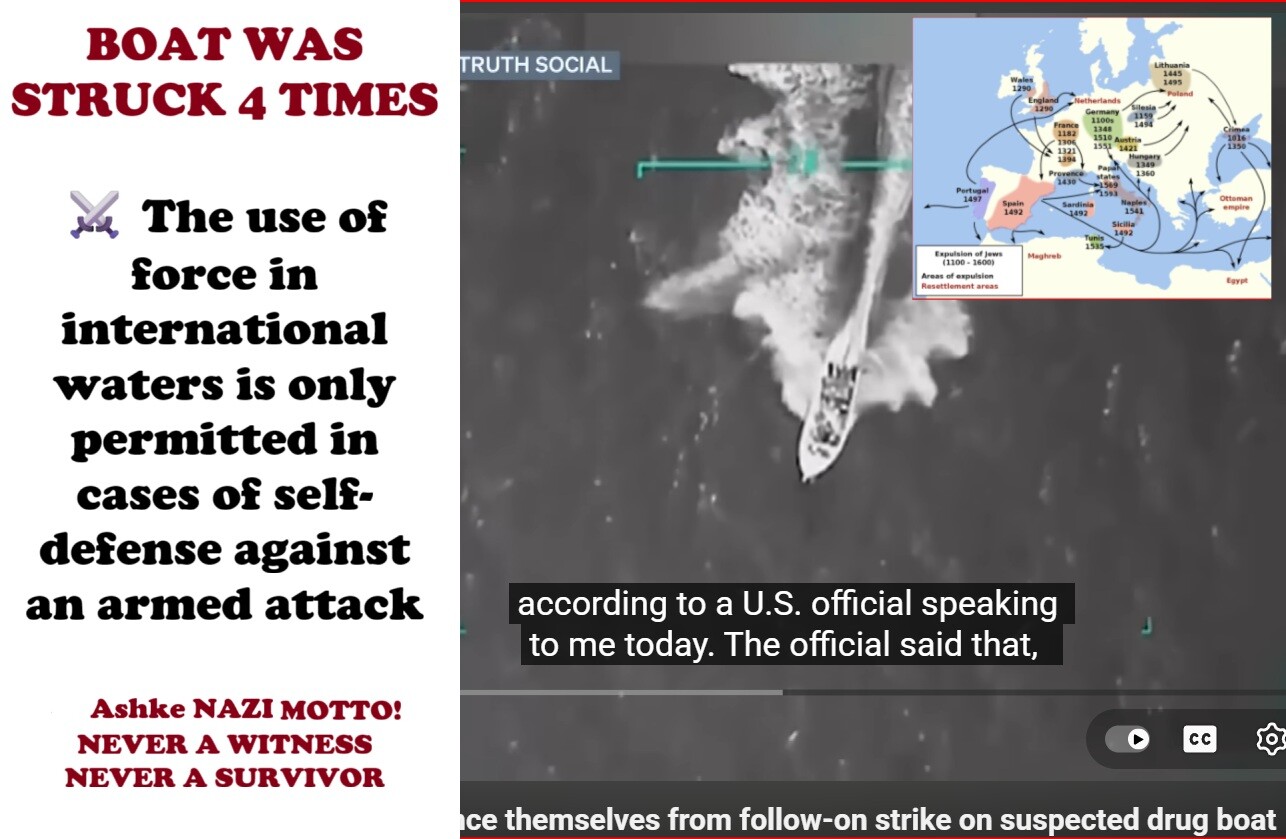
🚢 🚤 ⚓ BOAT WAS STRUCK 4 TIMES NOT 2
💣 💣 💣 💣
~1 is too many and a 1000 is never enough~
⚔️ The use of force in #International_Waters is #only_permitted in #cases of #self_defense #against an #armed_attack??? 🚢 🚤 ⚓
Trump and Hegseth distance themselves from follow-on strike on suspected drug boat. The first attack in the Trump administration’s campaign in the Caribbean has become the most contentious. A U.S. official tells PBS News the military struck an alleged drug boat four times on September 2. President Trump and Pete Hegseth defended the attack, but also distanced themselves from the follow-on strike that targeted people who weren’t killed by the first strike.
⚔️ #Fighting in international waters is highly regulated under international law, and the use of lethal force by states is generally prohibited except under specific, exceptional circumstances. International waters, or the high seas, are governed by the United Nations Convention on the Law of the Sea (UNCLOS), which reserves these waters for peaceful purposes and prohibits states from exercising sovereignty over them.
⚔️ All nations have freedoms such as navigation and overflight, but these are conditional upon adherence to legal frameworks that restrict the use of military force.
⚔️ The use of force in international waters is only permitted in cases of self-defense against an armed attack—provided it is immediate, necessary, and proportionate—authorization by the UN Security Council, or through previously agreed multilateral operations.
🚢 ⚓ 🚤 Vessels on the high seas are subject to the jurisdiction of their flag state, and boarding or use of force against them requires justification, such as well-founded suspicion of piracy, slave trafficking, or if the vessel is stateless.
Non-lethal measures are typically expected when intercepting vessels, and lethal force must be reasonable and necessary in self-defense when there is an immediate threat to life.
Recent incidents have highlighted tensions between national security claims and legal constraints. In September 2025, U.S. military forces destroyed a Venezuelan boat in the Caribbean Sea, killing eleven people, which President Donald Trump confirmed and justified as part of a campaign against drug trafficking.
The U.S. later expanded such operations into the eastern Pacific and asserted the existence of a “non-international armed conflict” against the Tren de Aragua criminal group, invoking war powers to justify targeting vessels.
However, no evidence has been made public to substantiate the allegations, and no claim of self-defense under Article 51 of the UN Charter was deemed valid, as the threshold of an “armed attack” was not met.
Experts widely regard such actions as legally questionable. The unilateral use of lethal force without multilateral authorization or clear self-defense justification may violate international law, including the UN Charter’s prohibition on the use of force (Article 2(4)).
Such operations could constitute war crimes if conducted outside self-defense norms, especially when targeting individuals suspected solely of drug trafficking.
The destruction of vessels without trial or verification raises serious concerns about human rights violations, particularly the right to life, and undermines principles of due process and state sovereignty.
Moreover, treating transnational criminal organizations as enemies in an “armed conflict” lacks legal foundation under international humanitarian law, which requires a certain intensity of hostilities and organized command structures—conditions not clearly met in this context.
Critics argue that this reclassification risks normalizing extraterritorial military actions and eroding the international legal order.
Attacks on vessels in international waters without proper legal basis may also trigger international responsibility for the violating state, including breaches of human rights and infringement of another state’s sovereignty.
While some suggest alternative law enforcement approaches—such as interception in contiguous zones or enhanced regional cooperation—current practices appear to prioritize security over legal compliance.
In sum, while states face real threats from transnational crime, the use of force in international waters must conform to established legal standards. Unilateral military strikes, particularly those resulting in loss of life without transparent justification, challenge the rule of law at sea and risk setting dangerous precedents for future conduct on the high seas.
https://youtu.be/sjNfTGCkTjE?si=V_z42pCAnzbSPaSe
📛 DISCLAIMER: We Cover the 'Way' the #News is #COVERED_UP! 👿
WELCOME TO #DECENTRALIZED_GLOBALIZATION 🌐
WEBTRAFFICCOPS.COM TO THE RESCUE 🚑 NO NATIONALITY LEFT BEHIND | COMING SOON! 🌏 🌍 🌎
🔴 The #Next #Global_Superpower Isn't Who You #Think 🧠 WHO is TastingTraffic.com?
DavidV: 25 YEARS 24/7 Experience:
* Software Architect (PhD) Supervisor -25 years 300K PMS (project management) hours
* EXPERT BLACK BOX TESTER (1999)
* Founder of WebTafficCops.com the 1ST Dedicated CLICK FRAUD ENGINE on the Planet (1999)
* Founder of SEO (Search Engine Optimization, (1999)
* Founder of RTB (Real Time Bidding (1999)
* Founder of HFT (High Frequency Trading 2001)
* Founder of the first Screen Recorder (Applets) on the Planet (2000)
* Founder of DEVSECOPS (2000)
* Founder and CREATOR OF #BULLETPROOF #cryptocurrency FULL PRIVATE NODES via WWW since 2016 and MERCHANT INTEGRATION.
🍷 🍾 #TASTINGTRAFFIC_LLC | The Largest (WWW) #DIGITAL_TRAFFIC PROVIDER in the WORLD since 1999.
🌐 https://tastingtraffic.net/sitemap.xml
TASTINGTRAFFIC_LLC are NOT affiliates of this provider or referenced images used. This is NOT an endorsement OR Sponsored (Paid) Promotion/Reshare.